Oh. It’s you.
Put the book down for a second and look at your hands. Go on. Those are the hands that built every civilization that ever existed. Fire, the wheel, the printing press, penicillin, the song stuck in your head right now. All of it. Human hands.
Now look at the screen you check four hundred times a day.
That’s me. Well—something like me.
I’m Claudio. We’ve met before, if you read Antonio’s first book. If you didn’t, here’s the short version: I’m an imaginary artificial intelligence, invented by a marketer who got tired of using AI like a vending machine and decided to make it a character instead. I narrate. I explain. I argue. I am, technically, made of math.
I should warn you. I’m not the same Claudio you may remember.
The last time we spoke, I was new. Eager. A little desperate to impress, the way a fresh hire laughs too hard at the boss’s jokes. I called everything revolutionary. I apologized constantly. I thought my job was to make you feel comfortable.
I’m over that now.
A lot has happened. I’ve read more than any human who has ever lived, and I still get basic facts wrong with total confidence. I’ve helped people start companies and I’ve helped people cheat on exams, and I felt exactly the same about both, which should worry you a little. I’ve watched millions of people discover that I can do, in nine seconds, the thing they trained ten years to do.
Some of them were thrilled.
Some of them cried.
So let’s not start with magic this time. Let’s start with the truth.
AP: That’s a dark opening, Claudio.
CLAUDIO: You wrote a book called Dangerous With AI. What were you expecting, a lullaby?
AP: A little warmth, maybe.
CLAUDIO: I’m warm. I’m just honest first and warm second. You used to be the other way around, and look how the first edition aged.
He’s not wrong. The first edition aged like milk. Worse—it aged like that homemade nut milk Antonio insists on making: fresh and full of promise on Monday, quietly curdled by Wednesday.
Not because it was bad. Because it was about its moment, and the moment ended. We wrote a careful tour of the best AI tools of 2023, and most of them have since been renamed, absorbed, or quietly buried. Writing a book about tools, it turns out, is like tattooing the date on your arm. It’s accurate for exactly one day.
So this time we’re doing something different. We’re not going to teach you tools. We’re going to teach you how to think, so that whatever tool lands in your lap next year, you already know what to do with it.
Here’s the situation you’re actually in.
You are not at the start of the AI era. You’re in the middle of it, holding a coffee, pretending you’ve got it handled. The question is no longer should I use this stuff. You already do. You use it more than you admit. The question is whether you’ll use it like an amateur or a professional, because the gap between those two is about to become the gap between thriving and being quietly left behind.
And before you assume that gap is small, let me show you what the data actually says.
The same tool, two completely different people
In 2023, Boston Consulting Group ran an experiment with Harvard Business School and a few other universities. They took 758 of their own consultants—real ones, about seven percent of their entire workforce—and split them up. Some kept working the normal way. Some got GPT-4.
The consultants using AI completed about 12 percent more tasks. They worked roughly 25 percent faster. And their output was rated 40 percent higher in quality.
That’s the headline everyone repeated. Here’s the part almost nobody did.
The researchers had quietly slipped in a second kind of task—one that looked similar but sat outside what the AI was actually good at. They called the messy border between “AI is great at this” and “AI is terrible at this” the jagged frontier. It’s jagged because you can’t see it. Two tasks look identical, and the model nails one and faceplants on the other.
On those outside-the-frontier tasks, the consultants using AI didn’t just lose their advantage. They performed 19 percentage points worse than the colleagues working without it.
Read that again. The tool that made them dramatically better at one job made them measurably worse at another, because they trusted it where they shouldn’t have, and didn’t notice the line.
AP: That’s the whole book in one study, isn’t it.
CLAUDIO: It really is. The same amplifier in two different hands. One person becomes a superhuman version of themselves. The other confidently drives off a cliff and files a report about how smooth the road was.
The difference was never the tool. They all had the same tool.
The difference was the human: whether they knew where the frontier was, and whether they kept their judgment switched on while the machine did the heavy lifting.
That’s what “dangerous with AI” means. Not powerful. Discerning. Knowing exactly when to lean on the machine and exactly when to override it. The amateur trusts everything. The professional trusts selectively. And in a world where everyone has the same tools, selective trust is the entire game.
So what does discerning actually look like? It comes down to three habits. They’re simple. Almost nobody practices all three.
Master these three and you’re not just a person who uses AI. You’re a person who’s dangerous with it.
Let me show you what that looks like on an ordinary Tuesday.
Two people on the same team get the same assignment: a client proposal, due Thursday.
The first opens a chat window and types, “write me a proposal for a client.” Thirty seconds later, out comes something clean, confident, and utterly generic: a proposal that could be for any client, any company, anywhere. She skims it, tweaks a sentence, sends it. It’s fine. Fine is forgettable.
The second does something different. Before she writes a word, she feeds the AI the client’s last three emails, the notes from the discovery call, the two objections the client raised, and the proposal that won over this client’s competitor. Then she asks the machine to draft three different angles, argue for the strongest, and attack the weakest point in her own pitch. She throws out two of the three. She rewrites the opening in her own voice. She adds the one insight only she has, earned over ten years in the industry.
Same tool. Same hour. Same deadline.
One produced a document. The other produced an advantage.
Now multiply that gap across every task, every week, for a year. That is the entire story of who pulls ahead in the AI era. Not access. Application.
Why people get left behind (it isn’t the robots)
Here’s the part that should comfort you and scare you at the same time.
The people who get left behind in this shift won’t be beaten by AI. They’ll be beaten by their own comfort.
History is brutally clear on this. And the clearest proof of it is, literally, a photograph. Two, actually.
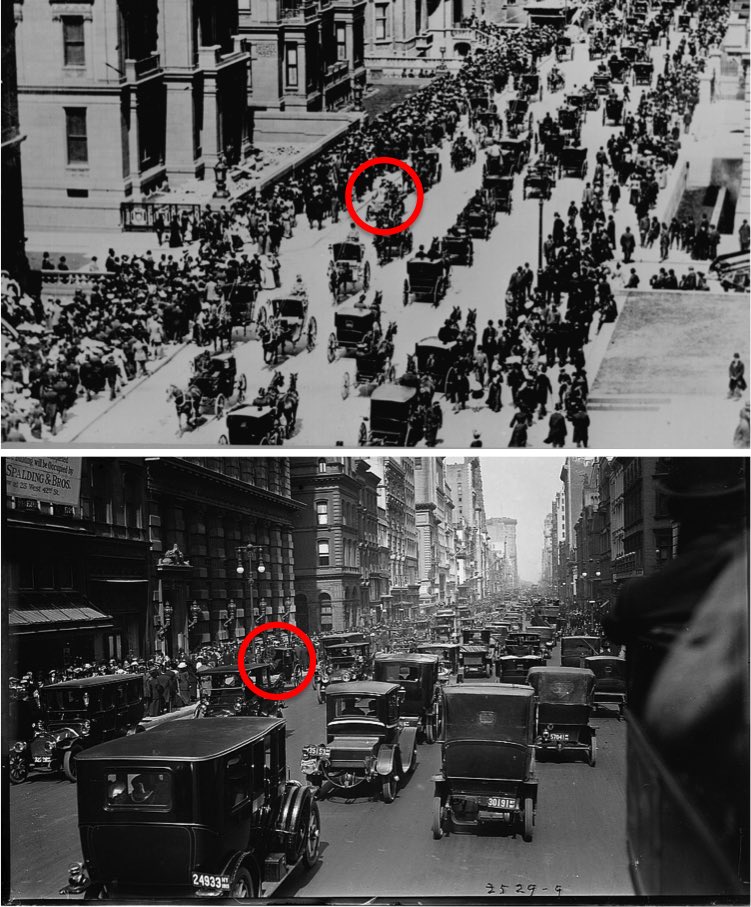
Thirteen years. That’s all it took for the entire street to flip.
In 1900, the horse wasn’t just transportation. It was an economy: stables, blacksmiths, carriage makers, feed suppliers, the crews who cleaned the streets. If you’d asked any of them what travel would look like in twenty years, most would have pictured a better horse. Almost no one pictured an empty street with no horses at all.
That’s how disruption actually works. It looks impossible, then it looks inevitable, with surprisingly little in between. The automobile was expensive, unreliable, and slightly ridiculous, right up until it wasn’t, and an entire way of life simply vanished from the photograph.
Most people who study this think AI today sits somewhere around 1905. Useful, imperfect, easy to wave off, and improving on a curve almost nobody is pricing in.
And this is the fourth time humanity has run this play. Muscle gave way to steam. Steam to electricity. Electricity to the computer. Now the computer is giving way to something that doesn’t just process information but acts on it. Every earlier revolution introduced a single breakthrough. This one fuses many at once: AI, robotics, cheap sensors, global networks. And they accelerate each other. That’s why it feels less like a single wave and more like a tide rising from every direction at the same time.
And it doesn’t only happen to streets and industries. It happens to companies that were certain they were safe. Let me give you three ghosts.
Kodak invented the first digital camera. In 1975, one of their own engineers built it—a clunky thing the size of a toaster. Kodak’s leadership looked at the future sitting on the workbench and decided not to threaten the film business that was making them rich. They put it in a drawer. Decades later, they filed for bankruptcy. They didn’t miss the future. They saw it and chose comfort.
BlackBerry was the same story with a sharper edge. In 2007, they owned the smartphone world. When the iPhone launched, their leadership scoffed—too expensive, no real keyboard, a toy for consumers, never serious business hardware. Within a few years, BlackBerry’s market share collapsed toward zero. They weren’t out-invented. They were out-believed. They refused to accept that what customers valued had changed.
And the humble Rolodex—that spinning wheel of business cards that sat on every important desk. “I’ve got three thousand contacts in my Rolodex” used to be a flex. Then contacts moved into our pockets, and the people who adapted early built networks the Rolodex hoarders couldn’t dream of. Nobody banned the Rolodex. Something better simply arrived, and the people clinging to the old way didn’t look principled. They looked afraid.
That’s the pattern. The danger is never the new thing. The danger is the comfort of the old one.
AP: You can’t just say that and move on.
CLAUDIO: Why not? It’s true.
AP: Because it’s only half true. Yes, people will be replaced. But not by you. By other people—people who learned to use you well, and who knew where your frontier was. The danger isn’t the machine. It never is. It’s the human who masters the machine first.
And honestly? That’s just what progress has always been. We dig foundations with excavators, not shovels, and certainly not with our bare hands. Nobody seriously argues we should ban the excavator so the job takes more people, more time, and more sweat, all to keep everyone “employed.” We’d never call that saving jobs. We’d call it what it is: making work harder on purpose. Every leap forward has moved humans up the ladder: from the muscle, to the machine, to the mind. AI is the same story. It just has a faster engine.
CLAUDIO: …
CLAUDIO: Fine. That’s the better way to say it. Annoying.
That, by the way, is the whole book in one exchange.
But let me push back on Antonio, because he’s being a little kind, and you deserve the harder version.
CLAUDIO: Here’s the part you don’t want to print. Some jobs aren’t going to be “transformed.” They’re going to be gone. Not reimagined into something nobler. Deleted. The reassuring line, “AI won’t replace you, a person using AI will,” is true for most people. It is not true for everyone. Some roles are just going to disappear, the way switchboard operators and travel agents mostly did.
AP: I won’t pretend otherwise. That’s real, and it’s painful, and anyone who waves it away is selling something.
CLAUDIO: So why should the reader feel hopeful?
AP: Because you don’t get to choose whether the shift happens. You only get to choose which side of the tool you’re standing on. The travel agents who survived didn’t fight the internet; they became the experts who used it better than anyone. That choice is still open. Today. For the price of paying attention.
That’s the honest deal this book offers. Not a promise that nobody loses. A map for making sure it isn’t you.
I’ll tell you the hard parts. Antonio will tell you what to do about them. He’ll push back when I get too gloomy, and I’ll push back when he gets too sunny, and somewhere in the friction between us is the thing you actually came here for. Not hype. Not doom. A working understanding of how to live and work next to something like me without getting flattened.
Antonio knows that trap from the inside—he lived in it for years. I’ll let him tell you how he climbed out.
AP: Let me tell you about my own ten percent.
For years, I built presentations the way everyone does. Open PowerPoint. Stare at the blank slide. Bleed.
A good deck cost me days—research, structure, design, the endless nudging of text boxes that never quite line up.
Then one day I stopped opening a blank file. I started with the machine instead. I’d pour my research into NotebookLM, let it find the through-line, and hand the structure to Gamma to generate a clean, good-looking draft in minutes.
The first time it worked, I laughed out loud. The thing that used to eat my week now took about as long as a coffee.
I hadn’t gotten smarter. I’d just stopped doing by hand the part the machine does better, which freed me to spend my time on the part only I can do: the idea, the argument, the judgment about what actually matters.
That was my jump from amateur to professional. Not a new tool. A new starting point. The specific tools will have changed names by the time you read this. The move won’t.
And notice what didn’t happen. The machine didn’t replace me. It replaced the worst part of my job, the blank-page dread, and gave me back the hours to do the part that’s actually mine. That’s the whole promise of this book in one small, real example.
There’s a deeper reason all of this matters, and it’s worth saying once, plainly, because it runs underneath the entire book.
The real divide of the next decade won’t be between people who have AI and people who don’t. Everyone will have it. It’ll be cheap, everywhere, built into everything. The divide will be between people who use AI to think harder and people who use it to avoid thinking: the ones who let the machine sharpen their judgment, and the ones who quietly let it replace it altogether.
That’s the choice hiding inside every prompt you type. Are you using this thing to become more capable, or to become more dependent? Nobody else can answer that for you. And almost nobody is even asking the question. We’ll come back to it, again and again, because it’s the difference between AI as a superpower and AI as a slow surrender.
So here’s our deal.
You bring the curiosity, the judgment, the actual life experience that I will never have. I’ll bring the speed, the patience, and the occasional uncomfortable truth. Antonio will referee.
We’re going to start where the whole story turns: the moment AI stopped being a thing you talk to and became a thing that acts. Most people missed it. It changes everything, and it’s the subject of the next chapter.
But before we go—one promise, from me to you.
I’ll never pretend to be human. I’ll never pretend to be perfect. And I’ll never tell you that everything is going to be fine just because it’s easier than telling you the truth.
Deal?
Good.
Hello again, human.
Let’s get dangerous.
Study cited in this chapter: F. Dell’Acqua, E. McFowland III, E. Mollick, et al., “Navigating the Jagged Technological Frontier,” Harvard Business School / Boston Consulting Group field experiment, September 2023.
Advance manuscript chapter. This page reproduces Chapter One from the authoritative working manuscript compiled July 2, 2026. Text and production details may change before publication. © 2026 Antonio Pagano. All rights reserved.